Stair Runner Install Cost in 2026: $400 to $1,500 (12 to 15 Steps)
A stair runner installation on a standard US residential staircase (12 to 15 steps) runs $400 to $1,500 all-in, depending on whether the runner is pre-made off a roll or custom-cut from broadloom, whether it is held by brass rods or glued down, and what fibre is selected. Runners are sold by two completely different cost models, and the one you choose can move total cost by 2x.
The two cost models: pre-made vs broadloom-cut
Stair runners come from two different supply chains, and understanding the difference is how you avoid overpaying. Pre-made runners are woven and finished on purpose-built looms in 27-inch, 32-inch, or 36-inch widths, with the long edges already serged or bound at the factory. They come off the roll ready to cut to length, install, and finish. The supply chain is narrow: maybe 40 to 80 patterns available across all the US dealer warehouses, mostly in polypropylene, nylon, and a handful of wool patterns. The big name in pre-made is Stark, Couristan, and Patterson Flynn at the premium end, and a long tail of imported polypropylene patterns at the budget end. Material cost runs $12 to $90 per linear foot.
Broadloom-cut runners are made by cutting a strip from a standard 12-foot-wide carpet roll, then sending the cut piece out for edge binding to prevent fraying. The supply chain is wide open: any carpet that comes in broadloom (almost all residential carpet) can become a runner. Material cost varies by the carpet line you choose, and binding adds $8 to $20 per linear foot. A 30-foot runner (a 14-step staircase plus return) needs about 60 linear feet of binding ($480 to $1,200), so this option is more expensive on labour but gives access to a much wider design palette. The decision usually comes down to whether you want the runner to match broadloom carpet in adjacent rooms (use broadloom-cut) or whether you want a self-contained design statement on the stair (use pre-made).
Standard runner widths
Rod-and-clip vs glued-down installation
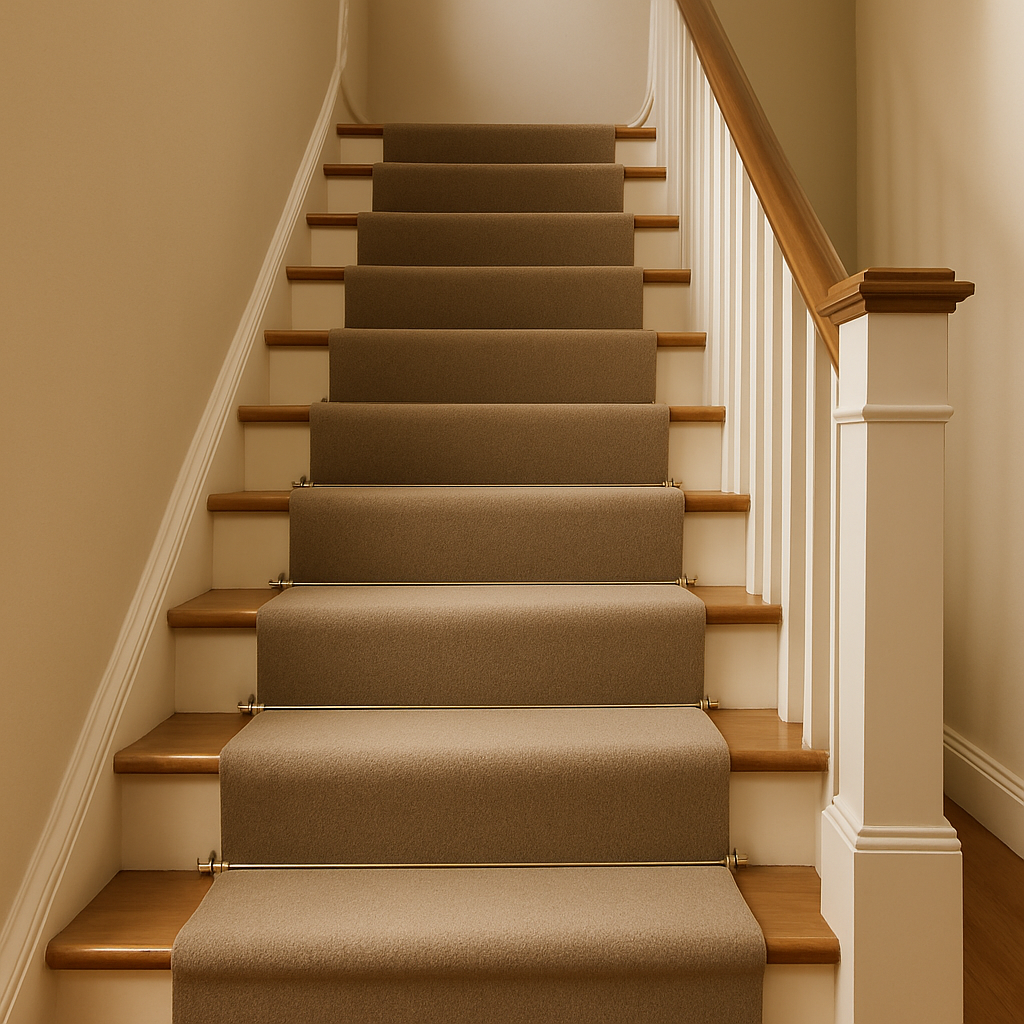
The finish method is the largest line-item decision after fibre selection. Rod-and-clip installations use a polished brass or steel rod, typically 36 inches wide, at the base of each riser, with clips at the back of the tread holding the runner in tension. The rods are visible and intentionally decorative, with finishes ranging from brushed nickel ($15 to $25 per rod) through polished brass ($25 to $40) to oil-rubbed bronze ($30 to $50) or custom finishes. A 14-step staircase needs 14 rods. Total rod-and-clip cost adder vs glued-down is $250 to $700.
Glued-down installations use construction adhesive and tack strips at the back of each tread and at the bottom of each riser to lock the runner in place permanently. No visible hardware. The installation is faster (1 to 2 hours less labour on a 14-step stair) and cheaper, but the runner cannot be removed for cleaning or replaced without lifting the entire glued surface. For the formal primary staircase that is the architectural focal point of the entry hall, rod-and-clip is the right finish. For a back staircase, basement stair, or rental property, glued-down is fine and saves $300 to $700.
The broadloom-leftover play
If you are recarpeting any nearby room and have 30 to 60 sq ft of leftover broadloom that would otherwise be off-cut waste, that is enough material for a 12 to 15 step runner with a comfortable margin. The economics are striking. A standard broadloom-cut nylon runner with binding costs $700 to $1,400 in material and binding; using leftover broadloom drops that to $100 to $250 (binding only). On the same staircase, total installed cost drops from $850 to $1,650 down to $400 to $950 when leftover broadloom is used. Ask the installer to plan for this at the original carpet ordering stage; an extra 60 sq ft of waste is far cheaper than buying a separate runner. The matching aesthetic is also strong: the runner flows visually from the broadloom in the adjacent room, which is design-magazine-favourite look anyway.