Cost to Install Carpet Over Concrete in 2026: $2.50 to $7 Per Sq Ft
Carpet installation over a concrete slab (basement, slab-on-grade home, garage conversion, addition) runs $2.50 to $7 per sq ft fully installed, a $0.30 to $0.80 per sqft premium over the same carpet installed over plywood. The cost stack changes in three places: moisture testing, tack-strip method, and pad spec. Get all three right and the install serves 10 to 15 years; get any wrong and you are looking at mould remediation within 2 to 3 years.
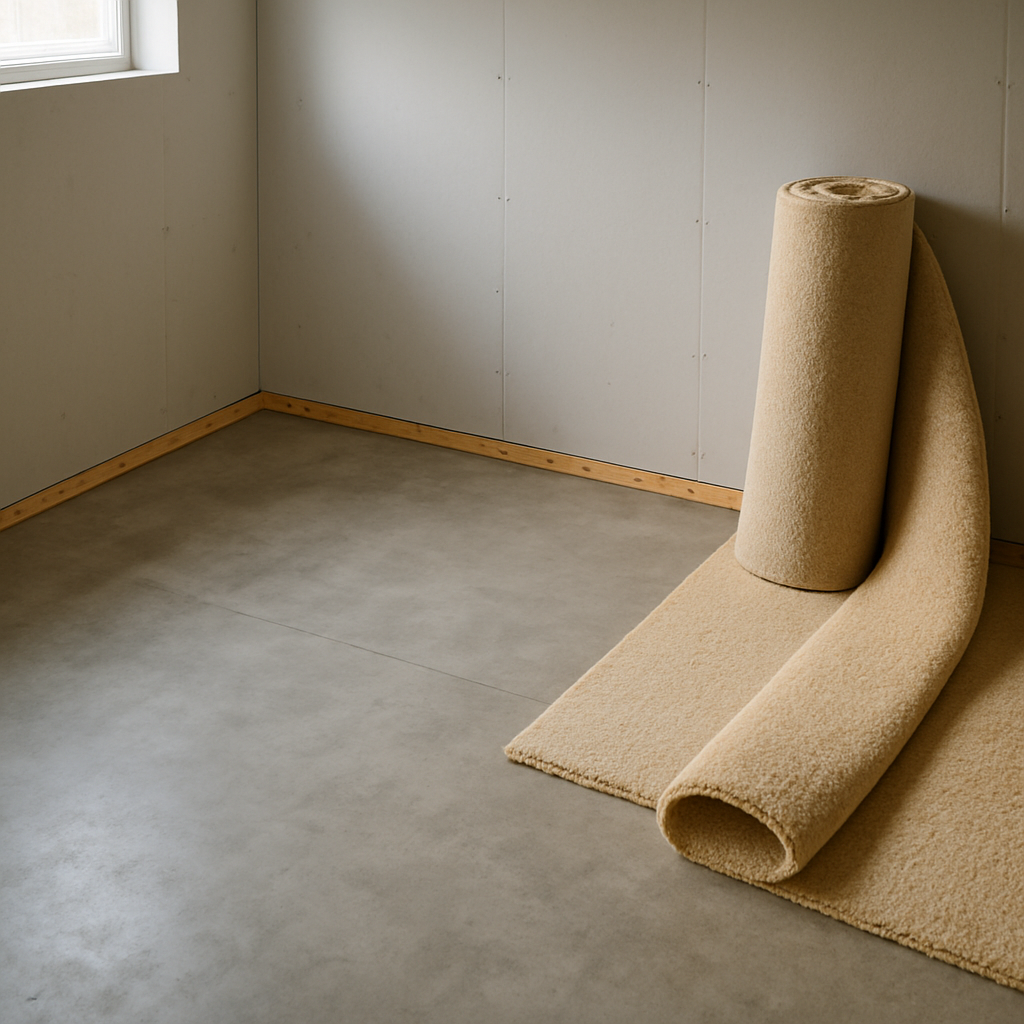
Concrete carpet starts with a moisture test
Concrete is hygroscopic. It absorbs and releases moisture from the surrounding environment continuously, and an apparently dry slab can still be emitting vapour at a rate that will damage carpet and pad over time. The Carpet and Rug Institute standard for carpet install over concrete requires moisture vapour emission below 5 pounds per 1,000 sqft per 24 hours (CC method) or below 85 percent relative humidity at depth (RH probe method). Many manufacturer carpet warranties are void on slabs that exceed those thresholds.
The calcium chloride test (CC test, ASTM F1869) is the older and cheaper option: tape a small sealed dish containing calcium chloride onto the slab for 60 to 72 hours, weigh the dish before and after, calculate the moisture transmitted into the dish. Test materials cost $30 to $50 and one dish covers 1,000 sqft. The relative humidity probe test (ASTM F2170) is more accurate, especially on thick slabs: drill a small hole, insert a probe to the appropriate depth, read RH after 72 hours of equilibration. Per-probe cost is $150 to $300 and you need one probe per 1,000 sqft. Either is acceptable; CC is the residential default and RH is the commercial default. Skipping the test is the single most common cause of basement carpet mould failure.
The tack-strip method choice
On a wood-floor install, tack strips are nailed to the subfloor with the small steel nails pre-installed in the strip; about 30 seconds per linear foot of install time. On concrete that approach does not work because the standard nails will not penetrate the slab. Two adaptations exist, each with its own trade-offs.
PSA tack strips have pressure-sensitive adhesive on the back, applied by peeling a release liner and pressing the strip onto the slab. They install fast and cheap (similar time to wood-floor install), work well on smooth, sound, dry slabs (the kind of slab found in homes built after 2000 with good vapour barriers under the slab), and fail on rough, damp, or older slabs. Failure mode: the adhesive releases over time, the tack strip lifts at the edge, and the carpet pulls away from the wall. PSA is the right choice when the slab passes all three: smooth, dry, and sound.
Concrete-nail tack strips come pre-loaded with hardened masonry nails (sometimes called drive pins) designed for driving into concrete with a powder-actuated nailer (Ramset, Hilti, similar). The installer can nail every 12 to 18 inches along the strip. More material cost (extra $0.40 to $0.80 per linear ft), slower install (1 to 2 additional hours per room), but reliable on any slab condition and effectively permanent once installed. The right choice on older slabs, on slabs that failed any portion of moisture testing, and on any slab where the install is expected to last 15+ years. Most reputable installers default to concrete-nail in basements and PSA only in newer additions with confirmed slab quality.
Pad spec for over-concrete install
Standard 8 lb rebond pad is the wrong spec over concrete. It absorbs vapour rising from the slab, holds the moisture against the carpet backing, and within 12 to 18 months can support mould growth. The right spec is one of three: vapor-barrier rebond (rebond foam with a polyethylene moisture-barrier film bonded to the underside, $0.50 to $0.80 per sqft installed), frothed polyurethane (closed-cell foam that does not absorb moisture, $0.50 to $0.75 per sqft installed), or rubber waffle (the most durable and mould-resistant option, $0.50 to $1 per sqft installed). The pad-spec premium over standard rebond is $0.20 to $0.30 per sqft, which on a typical 600 sqft basement install is $120 to $180. It is the highest-yield $150 you can spend on a basement carpet job.
Slab flatness and self-levelling prep
Concrete slabs in residential homes are rarely perfectly flat. The Carpet and Rug Institute spec for carpet install requires the slab to be within 3/16 inch over a 10-foot radius. Anything more uneven than that will telegraph through the pad and carpet as visible high spots and low spots, particularly under raked light. The fix is self-levelling concrete topping (Ardex, Mapei, Henry, all common brands), poured to a depth of 1/4 to 1/2 inch over affected areas, cured for 24 hours before carpet install begins. Material cost is $1.50 to $4 per sqft of self-levelled area, and most basement installs need 50 to 150 sqft of spot levelling rather than a full slab pour. Ask the installer during the initial walk-through to assess flatness and quote self-levelling separately; this line should not surface as a mid-job surprise.