Basement Carpet Cost in 2026: $2,240 to $7,680 (800 Sq Ft)
An 800 sq ft finished basement (the US average) costs $2,240 to $7,680 all-in for carpet, vapor-barrier pad, and labour, depending on fibre selection. Basement carpet is not the same product spec as upstairs carpet, and getting the difference right is what separates an 8-to-12-year install from a 3-year mould remediation.
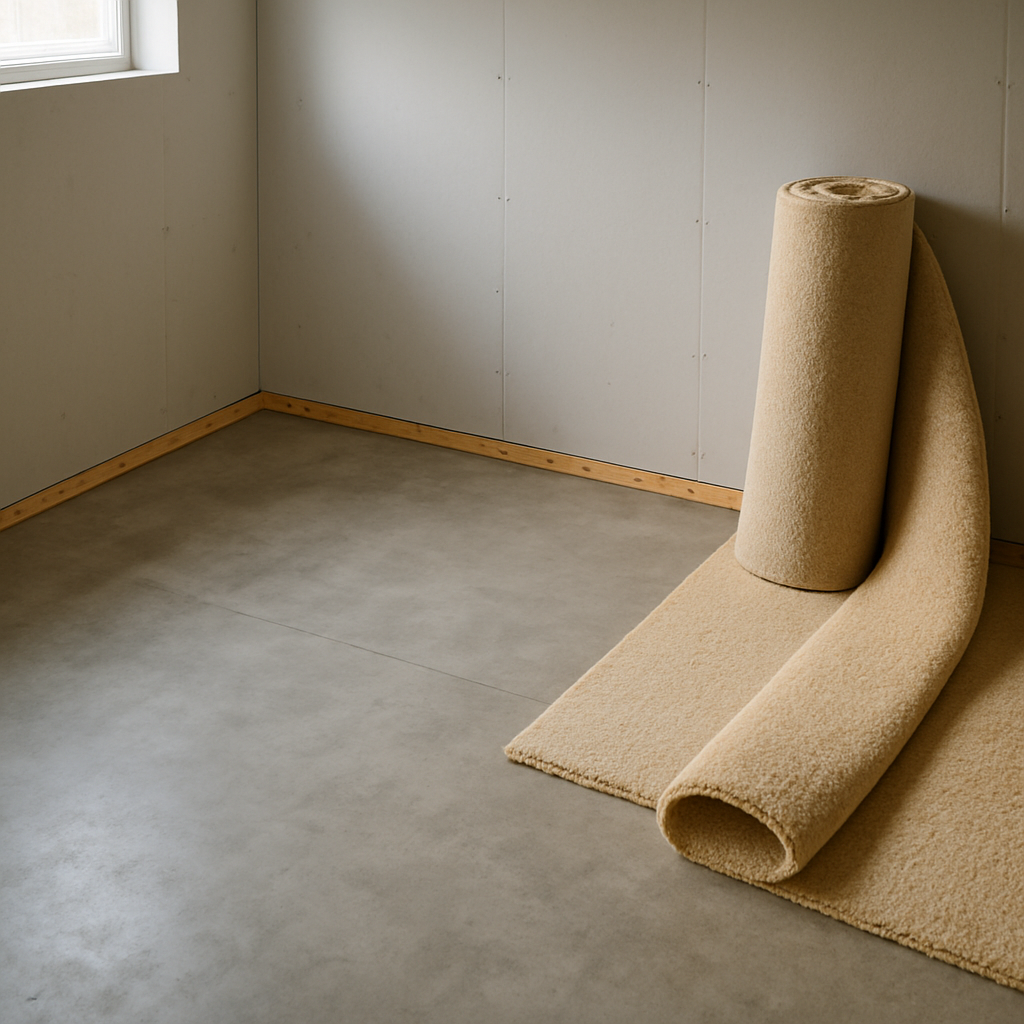
Why basement carpet is its own spec
The combination of a concrete slab below, a humid environment, and weaker airflow than the floors above makes the basement a fundamentally different installation problem from a bedroom or living room. A standard 8 lb rebond pad in a basement absorbs vapour rising through the slab, holds it against the carpet backing, and within 12 to 18 months supports mould growth that is invisible until the carpet is lifted. The carpet itself, if wool or wool-blend, behaves the same way: absorbing humidity, slow to dry, and prone to musty smell. Most basement carpet failures in US homes are not wear failures, they are moisture failures, and they happen because the install used the wrong spec for the environment.
The correct spec is built around three decisions made together. The pad must include a vapour barrier or be inherently moisture-resistant. The fibre must be hydrophobic (polypropylene, triexta, solution-dyed nylon). The installation method must use tack strips appropriate to concrete (PSA-back or concrete nails), not the wood-grade tack strips intended for upstairs floors. Get any of the three wrong and the install will fail prematurely; get all three right and the carpet will serve 8 to 15 years.
The moisture test that should happen before any quote
Concrete slabs continue to release moisture for years after they are poured, and even a 20-year-old basement slab can have a moisture profile too high for direct-glue or low-spec carpet install. The industry standard is to test moisture before any floor install, but in practice the test is skipped on plenty of residential basement jobs because the homeowner does not know to ask for it. The test pays for itself the first time it surfaces a problem that would have caused a callback.
Two tests are commonly used. The calcium chloride test (3-pound CC test, ASTM F1869) measures moisture vapour emission rate. Test materials cost $30 to $50, results are read 60 to 72 hours later, and the acceptable threshold for carpet install is below 5 pounds per 1,000 sq ft per 24 hours. The relative humidity probe test (ASTM F2170) measures moisture at depth, more accurate but more expensive, $150 to $300 per probe, and the threshold is below 85 percent RH. Either test is adequate. If you are getting quotes for a basement carpet install and no installer mentions moisture testing, ask why; the answer reveals whether you are talking to someone who understands below-grade install or someone who treats it as the same as an upstairs bedroom.
Padding selection
Fibre selection
The basement-fibre hierarchy is straightforward. Polypropylene (olefin) is the default budget choice and the workhorse of below-grade carpet. It does not absorb water, naturally resists mould, and runs $0.50 to $2 per sqft material. The downside is that polypropylene crushes faster than nylon under chair-leg load, so spaces that double as TV rooms with heavy furniture will show wear patterns within 3 to 5 years. Triexta (Mohawk SmartStrand) is the upgrade option, with built-in stain resistance and materially better crush resistance than polypropylene. At $2.50 to $5 per sqft material it is twice the price, but lasts twice as long.
Solution-dyed nylon is acceptable in well-ventilated basements with consistent dehumidification (RH below 60 percent year-round) at $2 to $5 per sqft material. The "solution-dyed" qualifier matters: piece-dyed nylon has the colour applied as a coating that can wick and stain in humid conditions, while solution-dyed nylon has the colour spun into the fibre itself. Wool is the wrong fibre for basements. It absorbs 30+ percent of its weight in moisture from the air alone, dries slowly, and develops musty odour. Spend the premium on a different room.
Concrete prep and installation method
Carpet install over concrete requires three method changes from upstairs install. First, tack strips: standard tack strips have nails meant for plywood subfloor; on concrete you need either tack strips with masonry nails pre-installed (sometimes called concrete-nail tack strips) or PSA-back tack strips that adhere with pressure-sensitive adhesive. The installer's choice depends on the slab condition; on smooth, sound slabs PSA is cleaner, on rough or older slabs masonry nails hold better. Second, flatness: carpet over a slab with high spots or low spots will telegraph the unevenness through the carpet visibly. A self-levelling concrete topping ($1.50 to $4 per sqft, applied at 1/4 to 1/2 inch thick) fixes this, and many basement installs need 50 to 150 sqft of spot levelling at minimum. Third, transitions: the carpet-to-stair transition at the bottom of the basement steps is a tight tolerance install that adds 1 to 2 hours of skilled labour.
The combined impact: basement install labour typically runs 10 to 25 percent higher per sqft than an equivalent upstairs install on the same total square footage. That is a real difference, and any quote that prices basement carpet at the same per-sqft rate as upstairs install is likely cutting one of these three corners.
Sump pump and flood-protection considerations
If the basement has a sump pump, plan the layout so the pump access lid is not covered by wall-to-wall carpet. The standard solution is a 24×24 inch tile, vinyl square, or removable carpet square directly over the access lid with a transition strip to the surrounding carpet. This adds $50 to $150 to the install and saves a $500 to $2,000 emergency-callout cost if the pump needs servicing during a heavy rain. For basements without battery-backup sump pump, the single most cost-effective upgrade you can make before carpeting is a $300 to $500 backup system; basements with battery backup have roughly half the flood-loss carpet-replacement rate of those without. The carpet itself is rarely the question; it is what is under and around it that determines lifespan.